TheGaggle
Politics • Culture • News
Our community is made up of those who value the freedom of speech, the right to debate and the promise of open, honest conversations.

We don't agree on everything but we never silence our followers and value every opinion on our channel.
Interested? Want to learn more about the community?

Brics power, y'all :)))

EndGame Macro
@onechancefreedm
Today Donald J. Trump announced what he described as a major trade agreement with Indian Prime Minister Narendra Modi. The U.S. tariffs on Indian goods would fall from 25% to 18%, India would move toward eliminating tariffs and non tariff barriers on U.S. products, and New Delhi would commit to purchasing more than $500 billion in U.S. energy, technology, agricultural goods, and coal. Most notably, Trump said India agreed to stop buying Russian oil.

Publicly, the deal was framed as a reciprocal trade win and a geopolitical step toward ending the war in Ukraine by cutting off a key revenue stream for Russia. Structurally, however, this is not a traditional trade pact. It functions as a sanctions enforcement framework delivered through tariffs and market access rather than direct financial restrictions.

Energy Is The Enforcement Mechanism

For nearly two years, India benefited from deeply discounted Russian crude, often 20–30% below Brent providing a meaningful subsidy to growth, inflation control, and the trade balance. Replacing those barrels with U.S. shale or Venezuelan heavy crude is not a neutral swap. U.S. oil is priced closer to global benchmarks, while Venezuelan crude introduces quality mismatches, logistical friction, and sanctions related costs. Even partial substitution raises India’s energy import bill and pressures its current account.

That is where the leverage lies. Tariff relief is conditional. If Indian refiners materially reduce Russian oil purchases, preferential access to the U.S. market remains. If flows revert, tariffs can be reinstated. In practice, tariffs operate as a secondary sanctions tool, applied through customs and trade policy rather than banking systems or payment rails.

Compliance Is Not Binary

The dominant narrative treats compliance as an on off switch. In reality, it exists on a spectrum. Oil can be blended, rerouted through intermediaries, or repapered through third countries. History shows energy markets adapt quickly when price incentives persist. The true test of this deal will not be press statements, but whether India’s crude import mix remains structurally altered over months, not days.

Second Order Effect With China

If India steps away from discounted Russian barrels, those volumes are likely redirected most plausibly to China, often at deeper discounts. That outcome would only partially weaken Russia while quietly subsidizing Chinese industry through cheaper energy inputs. A policy intended to pressure Moscow could unintentionally improve Beijing’s terms of trade.

Why Venezuela Matters

Venezuela’s inclusion as a substitute supplier is revealing. It signals a pragmatic U.S. shift..energy price stability and geopolitical leverage now outweigh ideological consistency on sanctions. Allowing Venezuelan barrels back into circulation creates a pressure valve that helps contain oil prices while enforcing compliance elsewhere.

What This Deal Really Does

The agreement seeks to fracture the Russia,India and China energy triangle by pulling New Delhi closer to a U.S. centric energy and trade orbit. It leverages India’s reliance on U.S. market access to reshape geopolitical behavior without deploying new financial sanctions or direct confrontation.

Whether it succeeds depends on execution. The key indicators will be India’s realized oil imports by origin, the durability of tariff relief, the persistence of Russian crude discounts into Asia, and whether diverted supply ultimately strengthens China more than it weakens Russia.

My View

This is a framework of conditional coercion, using tariffs as enforcement and energy flows as leverage. The immediate optics favor the United States, but the long term outcome hinges on compliance mechanics and second order effects particularly whether strategic advantage quietly shifts to China. The headline celebrates tariffs and friendship. The real story is about leverage, enforcement, and who ultimately absorbs the displaced barrels.


Interested? Want to learn more about the community?
What else you may like…
Videos
Posts
Articles
Monday Night At The Movies: "Double Indemnity" (1944)

Join Gagglers for "Double Indemnity"!

The screening starts at 3 p.m. ET sharp.
Share all of your thoughts, comments and criticisms on the Live Chat.

01:47:55
February 01, 2026
TG 2063: Trump's Plan To Take Over Cuba

George Szamuely and Peter Lavelle discuss President Trump's evolving plan to take over Cuba--a color revolution, but with a twist.

00:57:22
January 30, 2026
TG 2061: Can Trump's Attack On Iran Be Prevented?

George Szamuely and Peter Lavelle discuss President Trump's upcoming now-apparently-irreversible attack on Iran and wonder why he is doing it and whether it can be prevented.

01:20:05
14 hours ago
19 hours ago

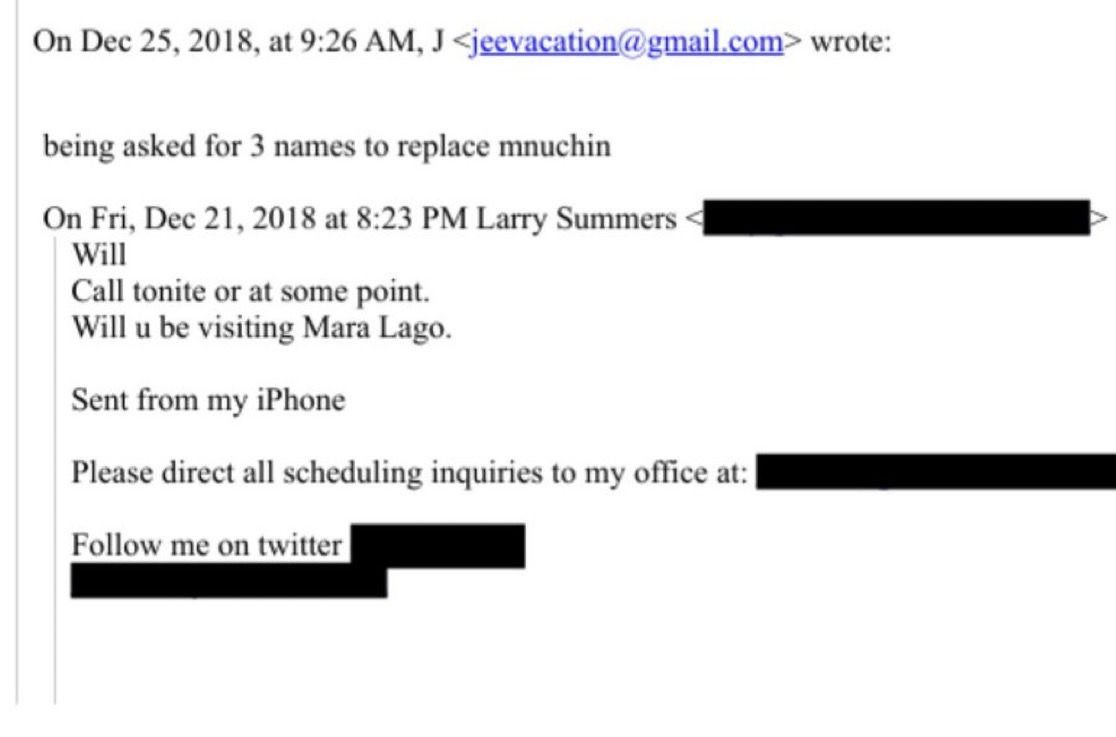
Former U.S. Treasury Sec Larry Summers emailed Epstein saying the real Vatican drama wasn’t the Pope quitting, it was the bank getting new leadership.

He said the Vatican’s bank helps rich people move money secretly since it doesn’t follow EU rules.

Also said the old bank president got fired during a bribery investigation, had 47 secret files at home, and was scared he'd be killed for knowing too much.

Just Summers casually breaking all this down to Epstein.
https://x.com/SimonDixonTwitt/status/2018078153978118616?s=20
Holy shit, no wonder this interview was never released

Jeffrey Epstein claims he was on the phone with Alan Schwartz & Jes Staley of $JPM during the 2008 Bear Stearns collapse while he was in jail for sex crimes

In 2023 Jamie Dimon testified under oath he never knew Epstein https://x.com/FinanceLancelot/status/2018109121904394476?s=20

Financelot
@FinanceLancelot
·
22 h
Every single time the Dow Jones to Gold Ratio has fallen like this (every 45ys) it's marked the transition to a new economic system:

Banking Act of 1933, concentrating power among a few banks.

1980 Reaganomics Era, regulation, spending cuts, monetary policy & inflation controls

January 21, 2023
More Leftie Than Thou
"Jacobin" Magazine Celebrates A Strike Against Ol' Blue Eyes

Here at "The Gaggle" we have very little time for the "more Leftie than thou" school of thought--that's the approach to life according to which the only thing that matters is whether you take the right position on every issue under the sun from Abortion to Zelensky. No one in the world meets the exacting standards of this school of thought; any Leftie leader anywhere is always selling out to the bankers and the capitalists. The perfect exemplar of this is the unreadable Jacobin magazine. 

The other day I came across this article from 2021. It's a celebration of trade union power. And not simply trade union power, but the use of trade union power to secure political goals. Of course (and this is always the case with the "more Leftie than thou" crowd), this glorious, never-to-be-forgotten moment on the history of organized labor took place many years ago--in the summer of 1974 to be exact. Yes, almost half a century has gone by since that thrilling moment when the working-class movement of Australia mobilized and prepared to seize the means of production, distribution and exchange. 

Well, not quite. Organized labor went into action against...Ol' Blue Eyes, the Chairman of the Board, the Voice; yes, Frank Sinatra. Why? What had Sinatra done? Sinatra was certainly very rich, and he owned a variety of properties and businesses. But if the Australian trade union movement were, understandably, searching for the bright, incandescent spark that would finally awaken the working class from its slumber there were surely richer, greedier, more dishonest, more decadent, above all more Australian individuals it could have discovered. Australia was never short of them. Rupert Murdoch immediately springs to mind. Why Sinatra?


Only for Supporters
To read the rest of this article and access other paid content, you must be a supporter
Read full Article
See More
Available on mobile and TV devices
google store google store app store app store
google store google store app tv store app tv store amazon store amazon store roku store roku store
Powered by Locals