TheGaggle
Politics • Culture • News
Our community is made up of those who value the freedom of speech, the right to debate and the promise of open, honest conversations.

We don't agree on everything but we never silence our followers and value every opinion on our channel.
Interested? Want to learn more about the community?

Buy bitcoin, xrp, they said

People are still confused why $BTC tanked so quickly.
The Epstein documents revealed it was created by the NSA & promoted by the Epstein's wealthy elite

If that doesn't scare you I don't know what will. It will bounce, but ultimately it's going to $0 to implement the new system

Tradu postarea

Citat
Financelot
@FinanceLancelot
·
31 ian.
Interesting seeing Jeffrey Epstein was involved in $BTC back in 2011 and $XRP in 2014.

It seems the wealthy elite were behind this entire NSA experiment. https://x.com/FinanceLancelot/status/2020647818147623065?s=20

IS KEVIN WARSH ABOUT TO FLOOD MARKETS WITH LIQUIDITY OR TRIGGER A BOND MARKET RISK?

Recently, the upcoming Fed Chair Kevin Warsh has called for a new FED TREASURY ACCORD, basically a framework that would decide how the Fed and the U.S Treasury work together on debt, money printing, and interest rates.

This is not only about rate cuts.

Yes, markets expect Warsh to support rate cuts over time, possibly bringing rates down toward the 2.75%–3.0% range.

But the bigger story is what happens behind the scenes.

Warsh has long argued that the Fed’s massive balance sheet, built through years of bond buying pulls the central bank too deep into government financing.

So his plan could involve:

  • The Fed holding more short term Treasury bills instead of long term bonds.

  • A smaller overall balance sheet.

  • Limits on when large bond buying programs can happen.

  • Closer coordination with the Treasury on debt issuance.

And this is where history matters. Because the U.S. has already done something very similar before. During World War II, government debt exploded from about $48 billion to over $260 billion in just six years. To manage borrowing costs, the Fed stepped in and controlled interest rates directly.

Short-term yields were fixed near 0.375% and Long-term yields were capped near 2.5%.

If yields tried to rise, the Fed printed money and bought bonds to push them back down. This policy is known as Yield Curve Control. It helped the government borrow cheaply during the war.

But it came with consequences.

Once wartime controls ended, inflation surged sharply. Real interest rates turned negative. And the Fed lost independence over monetary policy. By 1951, the system broke down and the famous Treasury Fed Accord ended yield caps.

Now fast forward to today.

U.S. debt levels are again near World War II levels relative to the economy. Interest payments alone are approaching $1 trillion per year. Even a small drop in long term yields would save the government tens of billions in financing costs. That fiscal pressure is why Warsh’s proposal is getting so much attention.

Other countries also tried something similar.

  • Japan ran yield curve control from 2016 to 2024.

Its central bank ended up owning more than 50% of government bonds. Yields stayed low, but the yen weakened and bond market liquidity suffered.

  • Australia tried a smaller version in 2020–2021.

When inflation surged, they were forced into a messy exit that hurt central bank credibility.

Across all these cases, the pattern was similar:

Borrowing costs stayed low. Liquidity stayed high. Currencies weakened. Exits were difficult.

If Warsh’s framework leads to lower real yields, rate cuts, and easier liquidity conditions, that usually supports risk assets like equities, gold, and crypto.

Because when bond returns fall, capital looks for higher-return alternatives. But bonds themselves could face volatility.

Less Fed support for long term yields combined with heavy Treasury issuance could steepen the yield curve and push term premiums higher and that's why this could become the most important structural shift in U.S. monetary policy since the 1940s yield curve control era. https://x.com/BullTheoryio/status/2020802875413397774?s=20


Interested? Want to learn more about the community?
What else you may like…
Videos
Posts
Articles
Monday Night At The Movies: "Seconds" (1966)

Join Gagglers for "Seconds"!
The screening starts at 3 p.m. ET sharp.
Share all of your thoughts, comments and criticisms on the Live Chat.

See you at 3 p.m. ET

01:47:19
February 08, 2026
TG 2067: Is There More Or Less To The Epstein Affair Than Meets The Eye?

George Szamuely and Peter Lavelle discuss the Jeffrey Epstein affair: the misconceptions, the misinterpretations, the distortions and the injustices.

01:42:08
February 06, 2026
The Gaggle Music Club: Karol Szymanowski’s Violin Concerto No.1

This week’s selection for The Gaggle Music Club is Karol Szymanowski’s Violin Concerto No.1 Op.35.

Karol Szymanowski (1882–1937) is widely considered to be Poland’s most important 20th century classical composer. Before Szymanowski, Polish music lived largely in the long shadow of Chopin; after Szymanowski, it became an integral part of European modernism.

Szymanowski was born in Tymoszówka, in what was then part of the Russian Empire (today Ukraine), into a cultivated, landowning Polish family. His early musical education consisted of absorbing late German Romanticism—Wagner and Richard Strauss above all. His early works reflected this influence.

It was during the years of World War I that he began to express a distinctive style of his own. Between 1914 and 1918, he produced the works on which his reputation rests: Myths for violin and piano, the First Violin Concerto, the Third Symphony (Song of the Night) and the conception of the opera King Roger.

These compositions were neither ...

00:25:09
February 04, 2026
Monday Night At The Movies

Please choose which one of the following 8 movies you would like to have screened next Monday, Feb. 9.

The theme is "Bourgeois Life and Its Discontents."

Please continue to vote after Feb. 9, so that we can determine the runner-up. The runner-up will be screened on Feb. 16.

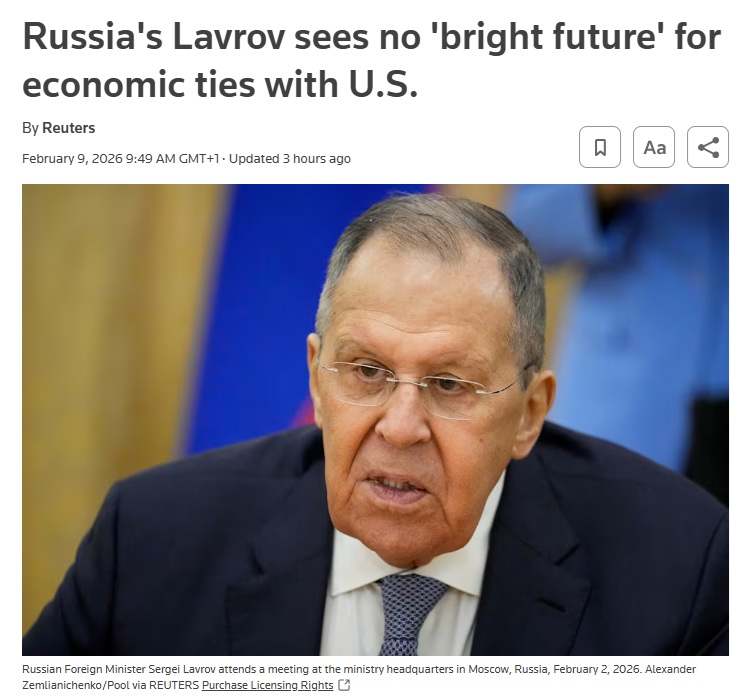
While Putin's envoy Kirill Dmitriev talks about the prospects for a “major restoration of economic relations with the US,” Russian Foreign Minister Sergey Lavrov sees “no bright future” in that direction.

Clearly, there is an ongoing “game of thrones” within
@mfa_russia
. https://x.com/nikola_mikovic/status/2020837307071520884?s=20 who will win, the sclerotic dinosaur fossil or the annoying piece of shit upstart?

Monday Night At The Movies: "Seconds" (1966)

Dear Gagglers:

Monday is, and has always been, a profoundly depressing day. That's why we have decided to add a little bit of fun to it.

On Monday, Feb. 9, we are holding another film screening. Gagglers can watch a movie and, as they do so, offer comments, random thoughts, aesthetic observations and critical insights in the Live Chat.

We will be screening the runner-up of The Gaggle's "Bourgeois Life and Its Discontents" poll: John Frankenheimer's terrifying masterpiece "Seconds," starring Rock Hudson.

The screening starts at 3 p.m. sharp.

https://www.imdb.com/title/tt0060955/?ref_=nv_sr_srsg_3_tt_6_nm_2_in_0_q_seconds

January 21, 2023
More Leftie Than Thou
"Jacobin" Magazine Celebrates A Strike Against Ol' Blue Eyes

Here at "The Gaggle" we have very little time for the "more Leftie than thou" school of thought--that's the approach to life according to which the only thing that matters is whether you take the right position on every issue under the sun from Abortion to Zelensky. No one in the world meets the exacting standards of this school of thought; any Leftie leader anywhere is always selling out to the bankers and the capitalists. The perfect exemplar of this is the unreadable Jacobin magazine. 

The other day I came across this article from 2021. It's a celebration of trade union power. And not simply trade union power, but the use of trade union power to secure political goals. Of course (and this is always the case with the "more Leftie than thou" crowd), this glorious, never-to-be-forgotten moment on the history of organized labor took place many years ago--in the summer of 1974 to be exact. Yes, almost half a century has gone by since that thrilling moment when the working-class movement of Australia mobilized and prepared to seize the means of production, distribution and exchange. 

Well, not quite. Organized labor went into action against...Ol' Blue Eyes, the Chairman of the Board, the Voice; yes, Frank Sinatra. Why? What had Sinatra done? Sinatra was certainly very rich, and he owned a variety of properties and businesses. But if the Australian trade union movement were, understandably, searching for the bright, incandescent spark that would finally awaken the working class from its slumber there were surely richer, greedier, more dishonest, more decadent, above all more Australian individuals it could have discovered. Australia was never short of them. Rupert Murdoch immediately springs to mind. Why Sinatra?


Only for Supporters
To read the rest of this article and access other paid content, you must be a supporter
Read full Article
See More
Available on mobile and TV devices
google store google store app store app store
google store google store app tv store app tv store amazon store amazon store roku store roku store
Powered by Locals