




TheGaggle
Politics • Culture • News
Our community is made up of those who value the freedom of speech, the right to debate and the promise of open, honest conversations.

We don't agree on everything but we never silence our followers and value every opinion on our channel.
Interested? Want to learn more about the community?
3 hours ago

Berlin and Hormuz: Two Conceptions of Power

The Berlin Airlift offers a noble counterpoint to what is happening today in the Gulf.

In 1948, the Soviet Union attempted to force the Western powers out of Berlin by cutting the city’s road, rail and water connections. Yet even at one of the tensest moments of the early Cold War, the supply aircraft themselves were not deliberately shot down. Soviet fighters buzzed them, searchlights harassed them and antiaircraft guns sometimes fired nearby, but the planes continued through the agreed air corridors. Moscow understood that destroying an American or British cargo aircraft would transform coercion into open war. (AF History)

The result was one of the noblest demonstrations of logistical power in modern history. Aircraft arrived carrying flour, coal, medicine and fuel not to conquer territory, but to sustain two million people trapped inside a political confrontation. More than 2.3 million tons of supplies were eventually delivered. The airlift demonstrated that the supply chain could stand above the struggle for political supremacy: it could become a protected artery of ordinary human life. (AF History)

The Gulf today presents almost the mirror image.

There, the arteries of economic life have themselves become the battlefield. Commercial vessels and their crews are being attacked; maritime traffic through the Strait of Hormuz has collapsed on some days from roughly 130 vessels to fewer than ten; ports are blockaded; and energy, water and transportation infrastructure have become instruments and targets of political coercion. Sailors who have no part in the quarrel are being killed while carrying the fuel and goods upon which people thousands of miles away depend. (AP News)

Berlin showed political powers restraining themselves, however reluctantly, before the boundary separating geopolitical conflict from the material sustenance of civilian life. The contest remained political, while the cargo planes were permitted to carry on the substantive work of civilization.

In the Gulf, that boundary is disappearing. Governments no longer merely struggle with one another around the supply chain; they struggle through it. The tanker, the cargo ship, the port, the refinery, the power station and even the desalination plant become pieces on the political chessboard. (The Guardian)

That is the deeper contrast. The Berlin Airlift treated logistics as a means of rescuing human life from politics. The Gulf crisis treats logistics as a means by which politics may hold human life hostage.

The lesson of Berlin was that the highest use of power is to keep the channels of human cooperation open. The tragedy of Hormuz is that political power, unable to produce the extraordinary system of exchange on which the world depends, nevertheless claims the authority to interrupt, commandeer and destroy it.

Interested? Want to learn more about the community?
What else you may like…
Videos
Posts
Articles
TG 2151: EU In Shock: Zelensky Fires "Beloved" Defense Minister

George Szamuely and Peter Lavelle discuss Ukraine President Zelensky's firing of his defense minister, Mykhaylo Fedorov. and reflect on why this has caused such spluttering outrage within the European Union.

01:26:31
Live Chat
Monday Night At The Movies: "The Night Of The Hunter" (1955)

Join Gagglers for "The Night Of The Hunter"!
The screening starts at 3 p.m. ET sharp.
Share all of your thoughts, comments and criticisms on the Live Chat.

See you at 3 p.m. ET

01:33:15
TG 2150: Lindsey Graham: Is The World Better Off Without Him?

George Szamuely and Peter Lavelle reflect on the life, death and legacy of Senator Lindsey Graham, and wonder whether one can conclude that the world is better off for his permanent absence.

01:36:31

You're invited for Saturday night ZOOM:

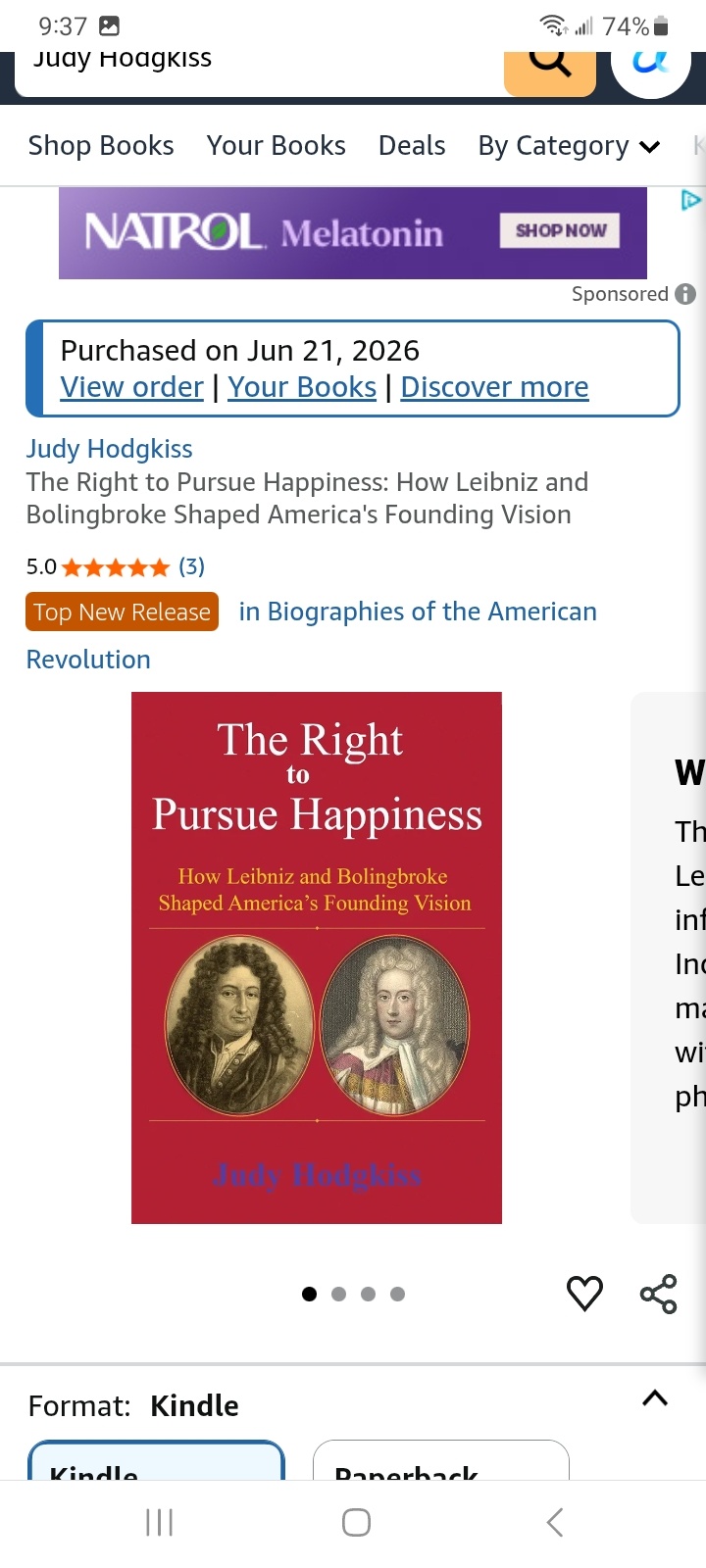
PART III, and final class, on my new book, The Right to Pursue Happiness: How Leibniz and Bolingbroke Shaped America’s Founding Vision:
Promethean PAC
Saturday Class—July 18—6pm et/3pm pt

What is "Happiness" in the Declaration of Independence?
ZOOM Info below.

“Wisdom is the Science of Happiness”: The Origins of the Declaration’s Happiness Doctrine

This last class of a three-part series by Judy Hodgkiss on her new book, The Right to Pursue Happiness: How Leibniz and Bolingbroke Shaped America’s Founding Vision, will address the central questions left open in the earlier classes: What did Leibniz and Bolingbroke truly mean by “happiness,” and why did the Declaration assert the right to it as unalienable and ordained by God?

The following “definition” of happiness offered by Gottfried Leibniz in a letter to his student, Christian Wolff, is a start—although it is not likely to satisfy the modern reader:

“In morals I set up our happiness as an end; ...

post photo preview

What Will It Take For Russia To End The NATO Proxy War? w/ John Helmer

Reason2Resist with Dimitri Lascaris

183K subscribers

Jul 16, 2026

In response to increasingly aggressive Ukrainian drone strikes on Russia, Russia's military recently launched a series of unusually severe missile and drone strikes on Kyiv, the Ukrainian capital.

Those Russian strikes, however, do not appear to have deterred Ukraine and its NATO backers from launching deeper and deeper drone and missile strikes into Russia.

Many Russians are increasingly frustrated and concerned by the Ukrainian strikes deep inside Russia.

Pressure is growing on the Russian government to be more assertive, but will it do what is necessary to deter NATO from arming and enabling Ukraine?

Dimitri Lascaris speaks with Russian affairs expert John Helmer about the difficult choices now confronting Russia's government.

3 hours ago

The global containerized supply chain is the Hanseatic League writ planetary: a transnational commercial order that privately coordinates ships, ports, insurance, credit, contracts and dispute resolution across political borders.

It operates in three fields.

The economic field builds the route and moves the cargo.

The administrative field stops, classifies and taxes it through tariffs, duties, excises, levies, inspections and fees.

The geopolitical field goes further: it seizes strategic nodes and turns the movement of goods into an instrument of power.

Today the Strait of Hormuz makes this third field unmistakable. The ships, oil, terminals, crews, contracts and navigation systems all still exist. What obstructs the flow is not an economic failure but a political struggle over who may command, threaten or close the route.

This is Franz Oppenheimer’s distinction in modern form: the supply chain is the economic means made global; the contest over Hormuz is the political means fighting to control ...

January 21, 2023
More Leftie Than Thou
"Jacobin" Magazine Celebrates A Strike Against Ol' Blue Eyes

Here at "The Gaggle" we have very little time for the "more Leftie than thou" school of thought--that's the approach to life according to which the only thing that matters is whether you take the right position on every issue under the sun from Abortion to Zelensky. No one in the world meets the exacting standards of this school of thought; any Leftie leader anywhere is always selling out to the bankers and the capitalists. The perfect exemplar of this is the unreadable Jacobin magazine. 

The other day I came across this article from 2021. It's a celebration of trade union power. And not simply trade union power, but the use of trade union power to secure political goals. Of course (and this is always the case with the "more Leftie than thou" crowd), this glorious, never-to-be-forgotten moment on the history of organized labor took place many years ago--in the summer of 1974 to be exact. Yes, almost half a century has gone by since that thrilling moment when the working-class movement of Australia mobilized and prepared to seize the means of production, distribution and exchange. 

Well, not quite. Organized labor went into action against...Ol' Blue Eyes, the Chairman of the Board, the Voice; yes, Frank Sinatra. Why? What had Sinatra done? Sinatra was certainly very rich, and he owned a variety of properties and businesses. But if the Australian trade union movement were, understandably, searching for the bright, incandescent spark that would finally awaken the working class from its slumber there were surely richer, greedier, more dishonest, more decadent, above all more Australian individuals it could have discovered. Australia was never short of them. Rupert Murdoch immediately springs to mind. Why Sinatra?


 

Only for Supporters
To read the rest of this article and access other paid content, you must be a supporter
Read full Article
See More
Available on mobile and TV devices
google store google store app store app store
google store google store app tv store app tv store amazon store amazon store roku store roku store
Powered by Locals